Portland Weekend Getaways: Olympic National Park
Mountains, rain forest, and a wild coast, all on one peninsula about four hours north of Portland. Here is how I would spend a long weekend driving the loop.
Somewhere north of Olympia, Highway 101 peels away from Interstate 5 and the trip changes character. The freeway noise drops off, Hood Canal appears on your right, and oyster shacks start turning up beside the road. For a Portlander this is the moment the weekend actually begins.
The Olympic Peninsula is the top left corner of Washington, and of the lower 48 for that matter. It is not a large piece of land, around 3,600 square miles, yet it holds glaciated mountains, temperate rain forest, deep lakes, and a long stretch of undeveloped Pacific shoreline. Olympic National Park, established in 1938, protects the mountainous interior plus a separate strip along the coast. It is also an International Biosphere Reserve and a UNESCO World Heritage Site, with close to a million acres of wilderness that no road crosses.
That last point matters for planning. You cannot drive through this park. You drive around it on Highway 101 and poke in at the edges, one dead end road at a time.
Getting there from Portland
Take I-5 north to Olympia, then follow 101 north along Hood Canal. Hoodsport is roughly two and a half to three hours from Portland on a good day. Port Angeles, the base for Hurricane Ridge, is more like four and a half. I like to run the loop counterclockwise, which is to say up the east side, across the top, down the coast, and home through Aberdeen. Traffic through Tacoma and Olympia on a Friday afternoon is its own kind of wilderness, so leave early or leave late.
The stops, in driving order
Staircase
Staircase is the first real corner of the park you reach coming from the southeast. Turn west on Highway 119 at Hoodsport and follow the north shore of Lake Cushman until the pavement gives up. There is a pleasant campground and a set of trails along the North Fork Skokomish River, with big trees, fallen logs the size of buses, and water running everywhere.
If the weekend is tight, this is the one to skip. If you have two or three spare hours, it is a gentle way to get your boots wet, possibly literally.
Hurricane Ridge
This is the headline act. Hurricane Ridge Road climbs about 20 miles from Port Angeles, uphill the whole way, to a mile high meadow with a view across the Olympic range in one direction and the Strait of Juan de Fuca in the other. Check your coolant and brakes before you go, especially in anything large, and check the weather too. The name is not a joke.
The old day lodge at the top burned down in 2023, so services up there are thinner than they used to be. Bring water and lunch.
For the views, do the Hurricane Hill trail. It starts from a small lot at the end of the road past the main parking area, climbs about 700 feet in 1.6 miles, and is paved most of the way. On the summit you get the full circle: mountains, strait, Vancouver Island, and on a clear day the North Cascades. On my visit a few mountain goats wandered through as if they owned the place. They were not native here, and the Park Service has since moved most of them out, so do not count on a repeat. The deer in the meadows are still reliably unimpressed by visitors.
Elwha
West of Port Angeles, the Elwha Valley holds the park’s largest watershed and one of the biggest river restoration projects ever tried. Two dams went up on the Elwha in the early twentieth century and blocked the salmon runs for a hundred years. Both are gone now, with the removal finished in 2014, and the river has been busy rearranging its valley ever since. It rearranged the road as well, so vehicle access is limited.
The quick stop is Madison Falls, less than five minutes on foot from the parking area just off 101.
Lake Crescent
Lake Crescent looks like a reservoir, and technically it does sit behind a dam. An ancient landslide built this one. The lake fills a glacial trough close to 600 feet deep, and the water is a startling clear blue because it is low in nitrogen and grows very little algae.
There is a classic old lodge on the south shore and two hikes that start from the same trailhead:
- Marymere Falls, about a mile each way, through a tunnel under the highway and into old growth forest. Easy.
- Mount Storm King, the best named peak in the park. Under two miles to the viewpoint, but it gains something like two thousand feet, and the final pitch uses ropes. Consider yourself warned.
Sol Duc Hot Springs
One of the few commercial corners of the park. It is a resort with pools fed by hot mineral springs, and it is the comfortable option if a tent in the rain has lost its charm. Reservations go early.
The Pacific beaches
There are more beaches here than a weekend can hold, so pick one or two.
- Rialto Beach: enormous driftwood logs piled along the shore, sea stacks offshore, dark forest behind.
- First, Second, and Third Beach: near La Push. First is the easiest and busiest. Third has the longest walk in and the fewest people.
- Ruby Beach: right off 101 and popular for good reason.
- Kalaloch: a lodge, cabins, and a long flat strand for walking.
These are not Cannon Beach. There are no taffy shops, the water is cold, and the tide will trap you against a headland if you ignore the tables.
Hoh Rain Forest
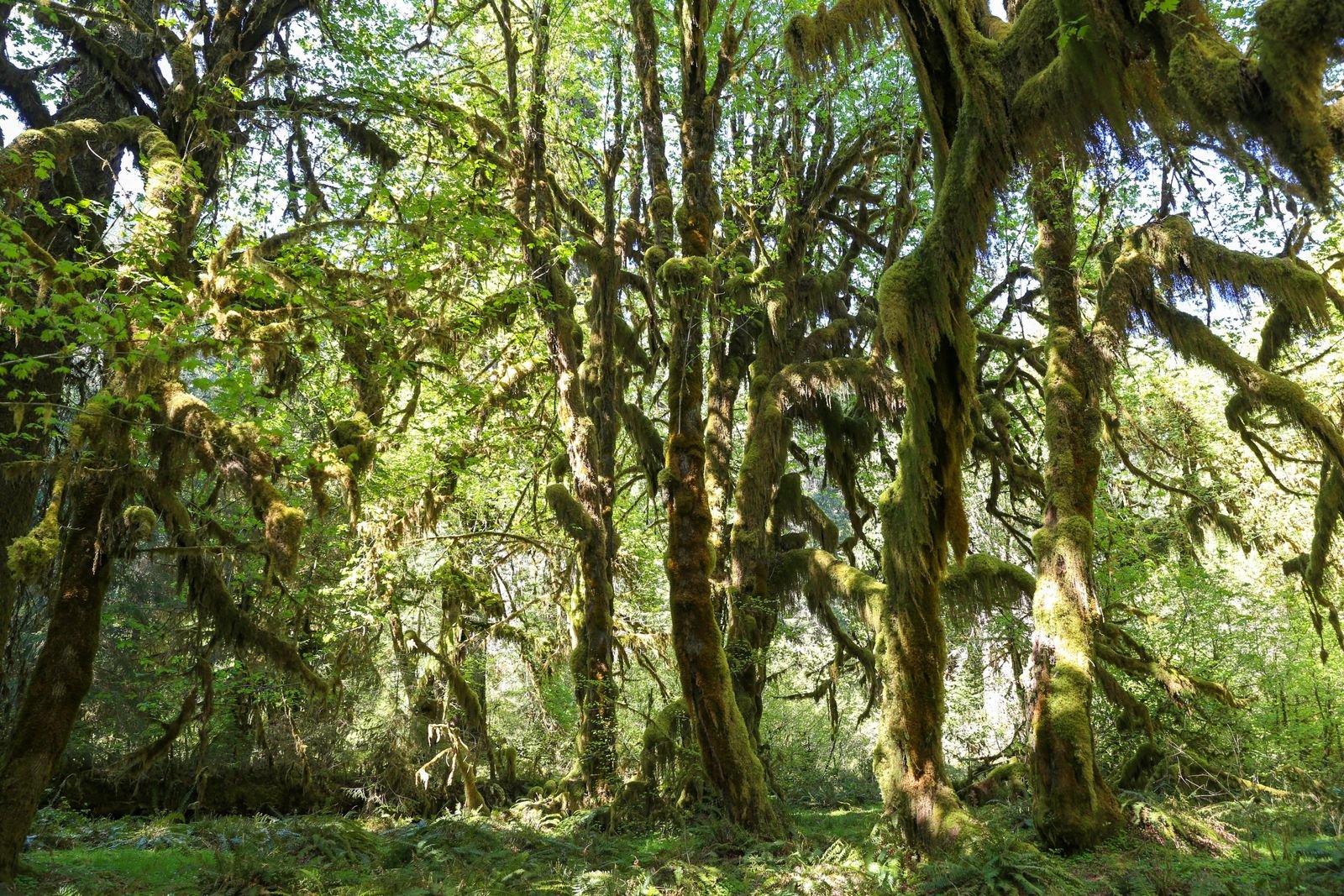
The Hoh River valley takes in well over a hundred inches of rain a year, and it shows. Moss hangs from every maple limb, ferns cover the ground, and Sitka spruce and hemlock close the canopy far overhead. This is what much of the coast from Alaska to northern California looked like before the saws arrived. Oregonians will feel a small pang of recognition.
Two short loops leave from the visitor center, the Hall of Mosses and the Spruce Nature Trail, and together they take about an hour and a half at a looking around pace. The Hoh River Trail continues some 17 miles toward Mount Olympus for those with a pack and a permit. The parking lot fills by mid morning in summer, and the entrance line can back up down the road, so arrive early.
Lake Quinault
The last stop before the highway bends toward home. The lake sits in its own rain forest valley in the southwest corner of the park, which gives it a mood unlike the usual summer lake. The Lake Quinault Lodge, built in 1926, is a fine example of the rustic style the Park Service and Forest Service favored in that era, with a big lobby fireplace made for wet afternoons.
A sample three day weekend
- Friday: Portland to Port Angeles via Hood Canal, with a stop at Staircase if you left early enough.
- Saturday: Hurricane Ridge in the morning, Lake Crescent and Marymere Falls in the afternoon, then on toward Forks.
- Sunday: Rialto or Ruby Beach at low tide, the Hoh by mid morning, a late lunch at Lake Quinault, and home through Aberdeen and Olympia.
It is a lot of driving. Two nights is the minimum, and three would be kinder. If you find you prefer your mountains bigger and your itinerary simpler, the other Washington weekend I recommend is Mt. Rainier.
What to pack
A raincoat in every season. A paper map, because cell coverage disappears for long stretches of 101. A tide table for the coast. And a full tank whenever you see a gas station, since the peninsula is generous with scenery and stingy with fuel.
- olympic national park
- weekend getaways
- washington
- hoh rain forest
- hurricane ridge
- road trips
- pacific coast