Portland Icons: The Steel Bridge and Its Telescoping Decks
It is big, black, and rarely on the postcards. It is also the only bridge of its kind anywhere, and it carries nearly every vehicle Portland has invented a lane for.
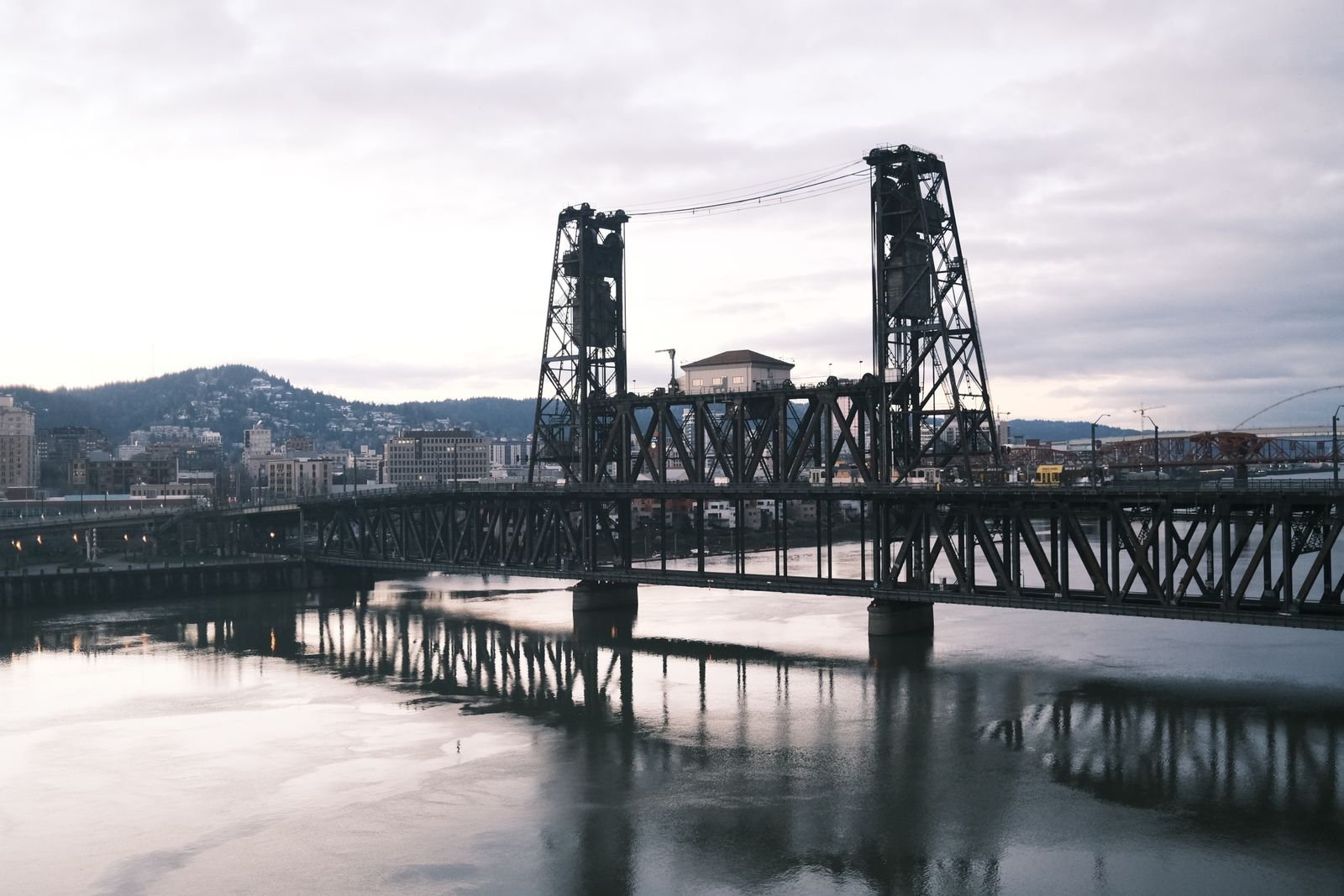
I had pictured the Steel Bridge before I ever saw it. I do that with bridges. My wife says it is part of my charm, and I have chosen to believe her.
The real thing did not match. It was bigger than I expected, blacker, and frankly a bit of a brute: two blocky towers, a tangle of trusswork, and a lift span hanging between them like a filing cabinet drawer. Stand at the north end of Waterfront Park and it fills the sky. It does not make many postcards, and you can see why. The St. Johns gets the calendars. The Steel gets the work.
Function first, and second, and third
What it lacks in looks it makes up in sheer cleverness. The Steel Bridge opened in 1912, two years after the Hawthorne just upstream, which makes it the second oldest vertical lift bridge still operating anywhere. The oldest is the Hawthorne. Portland has both, a fact we mention less often than we should.
But the Steel does something the Hawthorne cannot. It has two decks, and the lower one lifts independently of the upper. The lower deck sits only about 25 feet above the Willamette, low enough that a decent sized tugboat needs it out of the way. So the bridge tender raises just that deck, and it telescopes neatly up into the trusses of the upper one. Traffic overhead keeps rolling. Most drivers never know anything happened.
When a taller ship comes through, both decks go up together, well over a hundred feet above the water, and then everybody waits.
As far as anyone has been able to establish, no other bridge on earth works this way. It was designed by the Kansas City firm of Waddell and Harrington, who more or less wrote the book on vertical lifts, and they never repeated the trick.
How the lifting works
Those two ungainly towers are the whole secret. Inside them hang enormous counterweights, connected by cables that run over the big wheels you can see at the top. The weights balance the lift spans almost exactly, so as a deck rises its counterweight sinks, and the reverse.
The result is that a fairly modest motor can hoist an astonishing amount of metal. It is the same principle as an old sash window, scaled up to carry a freight train. Good stuff.
Everything that moves, on one bridge
The other remarkable thing is the traffic. I cannot think of another bridge that carries this much variety.
- Lower deck: Union Pacific freight trains, Amtrak passenger trains headed into Union Station, and a walkway for people on foot and on bikes.
- Upper deck: MAX light rail, buses, cars, and sidewalks on both sides.
The lower deck walkway is the newer piece. It arrived with the Eastbank Esplanade in the early 2000s, cantilevered off the south side of the bridge, and it joins the Esplanade directly to Tom McCall Waterfront Park. The upper sidewalks, by contrast, dump you into the street grid several blocks back from the river, which is fine if you are going to the Rose Quarter and annoying otherwise.
MAX has crossed the upper deck since the first line opened in the 1980s, and most of the system still funnels over it. A bridge finished before the First World War is the single busiest link in the regional rail network. Somebody at TriMet presumably loses sleep over that.
About that name
Here is a point of confusion I once had myself. The bridge is called the Steel Bridge because of its predecessor, an 1888 double deck swing bridge on almost the same alignment. That earlier bridge was built of steel when wrought iron was still the usual material, which was novel enough that the name stuck to it.
When the railroad replaced it in 1912, nobody bothered with a new name. The current bridge is steel too, so the label is accurate, just inherited. It is still a railroad bridge at heart. Union Pacific owns it, and the public gets the upper deck by lease.
Seeing it properly
Walk the lower deck. Start at the Friendship Circle at the north end of Waterfront Park, follow the ramp down, and you are suddenly a few yards above the river with the machinery over your head. If a freight comes through, it passes on the other side of a fence, close enough to feel in your chest. The walkway closes briefly when the lower deck lifts, which is the best show of all, so do not complain if you get stuck.
From the Esplanade side, look back for the full profile with downtown behind it. Evening is best, when the black steel goes to silhouette.
For the fellow bridge geeks
If the mechanics interest you, the Library of Congress has a wonderful set of technical drawings of the Steel Bridge online, made for the Historic American Engineering Record. They cover the other old Willamette River bridges too, including the Broadway Bridge one crossing downstream. Cutaway views, cable diagrams, counterweight details, all drawn with the kind of care the original builders would have recognized.
I have lost entire evenings to them. The bridge still is not pretty. I have stopped caring.
- portland
- steel bridge
- willamette river
- bridges
- vertical lift bridge
- max light rail
- eastbank esplanade
- engineering