Portland in Pictures: Pittock Mansion in Winter
Portland's most famous house is at its best on a cold clear day, when the lawn is empty and three volcanoes line up behind downtown.
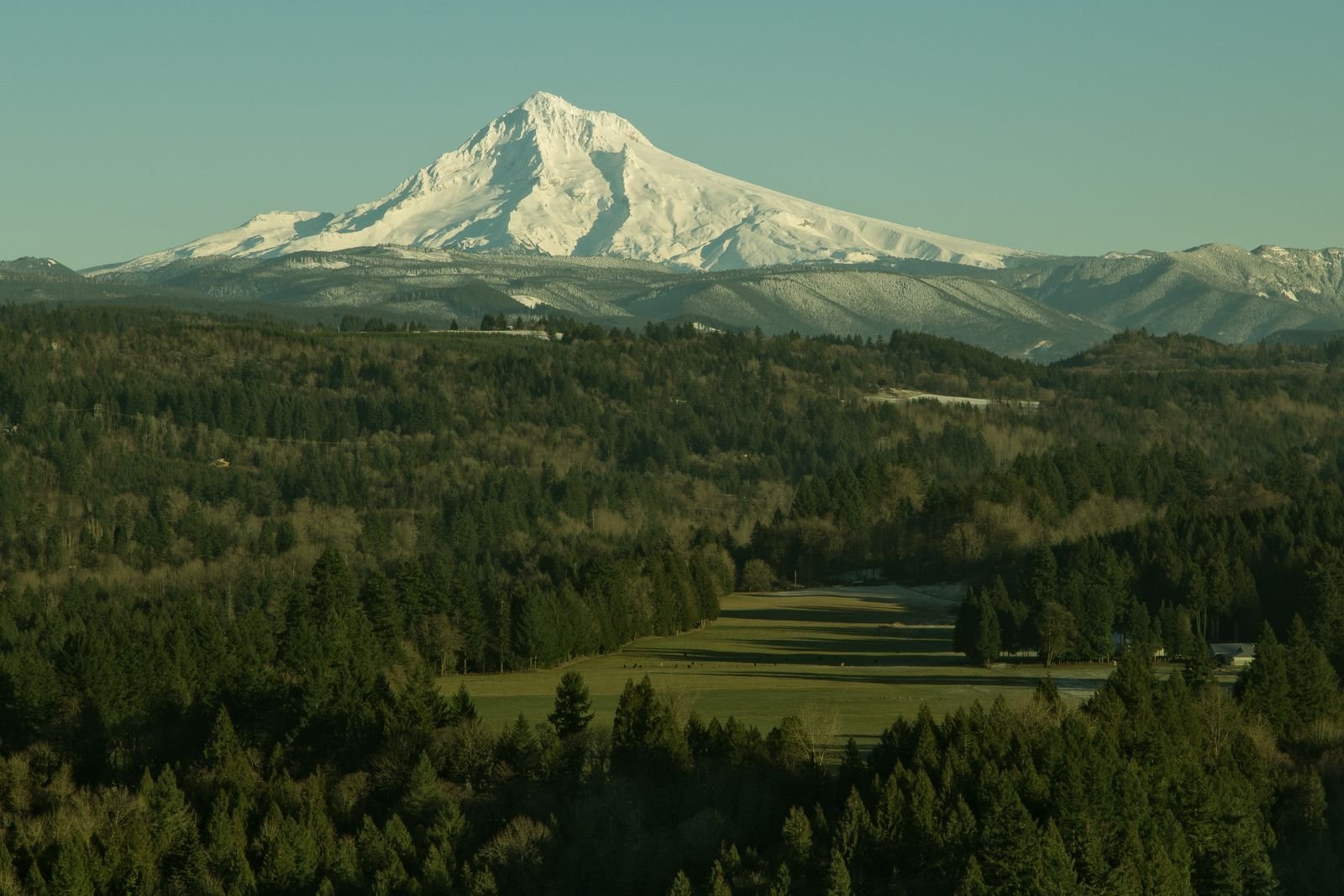
February, a weekday, a little after ten. The parking lot at the top of the hill had four cars in it and the lawn had nobody at all. That is the argument for seeing Pittock Mansion in winter. In July you share the view with a wedding party and two tour buses. In February you share it with a gardener and a crow.
It is probably the best known house in Portland, and for once the reputation is earned.
The house a newspaper built
Henry Pittock came to Oregon in the 1850s as a teenager with, by his own account, very little. He took a job at a small weekly called The Oregonian, ended up owning it, and turned it into the daily paper that ran the state’s conversation for generations. Along the way he got into paper mills, real estate, banking, and most other things that made money in a young timber town. He was also a serious mountaineer, part of one of the earliest recorded climbing parties on Mount Hood.
That last detail matters, because when he and his wife Georgiana finally built their grand house, they put it where the mountain would be in the window.
Work began in 1909 and the Pittocks moved in during 1914. The architect, Edward Foulkes, gave them a French Renaissance chateau in pale sandstone, curved at the corners, with a red tile roof, set on a ridge roughly a thousand feet above the river. The Pittocks were both elderly by then. They had only a few years in the place before they died, which is the melancholy note under all the grandeur.
What luxury meant in 1914
The inside tour is the only part you pay for, and it is worth it. Not for the gilt, though there is some, but for the gadgets. The house had a central vacuum system, intercoms, an elevator, and indirect lighting, all very advanced for the time.
And the shower. Henry’s bathroom has a contraption with a ring of nozzles aimed at the bather from every conceivable direction, plus a few inconceivable ones. Evidently the height of luxury in the early 20th century was being sprayed in the kidneys. I think about that shower more than I should.
Nearly lost, in the usual Portland way
Family members lived in the mansion until the late 1950s, then put it up for sale. No buyer came. The house sat empty, and there was talk of clearing the hilltop for a subdivision.
Then came the Columbus Day storm of October 1962, the worst windstorm in the region’s recorded memory. It tore at the roof and let the rain in, and water did what water does to an unheated house. Demolition started to look like the tidy solution.
This city has a long record of knocking down its best buildings and feeling terrible afterward. Here, for once, the feeling arrived early. Residents raised money, the city put up the rest and bought the estate in the mid 1960s, and after a careful restoration the mansion opened to the public as a museum. It has been one ever since. I like to think the people who wrote those small checks drive past the West Hills and feel smug. They are entitled.
The view from the lawn
My favorite thing about the place is not the house at all. Walk around to the east side, past the flower beds (bare dirt and pruned stubs in February, which has its own honesty), and stand at the edge of the lawn.
Below you is the whole city. Beyond it the east side flattens out toward Gresham, and beyond that the Cascades, with Mount Hood dead center. On the day I visited the mountain was white from summit to treeline and looked close enough to walk to. Off to the left, Mount St. Helens sat with its flat broken top, and behind it the broad shoulder of Mount Adams.
You can get mountain views from Washington Park and from Council Crest too. What sets this one apart is the angle. The mansion sits farther north and west than the other overlooks, so you look across at downtown rather than down on its roofs. You see the entire skyline, base to top, with the bridges strung along the river, and not just the upper floors of the tallest towers poking above the firs.
Winter helps. Cold air after a front is clear air, and the low sun puts shadow and relief on the mountains that summer haze wipes flat.
What I photographed
- The mansion from the drive, sandstone gone almost gold in the low light
- The grounds in February, empty and clipped
- The north end of downtown, with the bridges
- The south end of the city with the Cascade foothills behind
- Downtown with Mount Hood directly over it, the shot everybody takes, for good reason
- Mount St. Helens and Mount Adams together in one frame
- One of a bare tree against the sky that has no documentary value whatsoever. I just liked it.
If you go
- Grounds and viewpoint: free. Bring lunch in warmer months, there are worse picnic spots.
- House tour: paid admission. Allow about an hour.
- On foot: the Wildwood Trail runs right through the property. The climb from Lower Macleay Park through Forest Park is a few miles of steady uphill and ends, satisfyingly, at the view.
- Weather: check the forecast for the mountain, not the city. Portland can be bright while Hood hides in cloud all day.
- Ice: the road up is steep and twisting. After a real freeze, wait a day.
One piece of trivia to finish. The mansion was the finish line for the thirteenth season of The Amazing Race, which means a pair of exhausted contestants once sprinted across that same lawn toward a television host. I walked across it slowly, with coffee, and had the better morning.
- portland
- pittock mansion
- west hills
- mount hood
- viewpoints
- henry pittock
- historic houses
- winter